Showing posts with label For the greater good. Show all posts

Saturday, May 19, 2012

From Art to Chemistry

I didn’t understand art very well when I was little. I thought it was useless, pointless, and boring. Art class was a pain for me, because I couldn’t figure out the purpose of it. All I can draw is straight lines, circles, and triangles.

Later in my life, as my experience grew, I noticed that art is useful in many ways. Sometimes it is used to put a message in pictures, like in road signs. Sometimes it is about creating feelings for people visiting a place like the decoration of modern hotels or traditional Chinese restaurants. After realizing this, I began to wonder how artists create things that look beautiful and interesting among so many possibilities. What exactly in art makes us feel that way?

I think the relationship between neuroscience and art is similar to that between physics and chemistry. Physicists are trying to know the basic workings of atoms and particles. Chemists are dealing with the function of different combinations of atoms. Neuroscience is the study of the nervous system, the inner workings of the brain, and human psychology. And I think what artists are trying to do is use tools to interact with our brains without first knowing how our brains work. This is not a bad thing because chemists in the 19th century also knew so much about many chemical elements and made great use of them without first knowing exactly how atoms work.

For me, art is just like a chemistry experiment. Artists put many colors, materials, shapes, and sounds together to see what happens when people see them. Chemists add different combinations of elements with different temperatures and quantities together to see what they will produce. I think modern art, which has a tendency toward abstraction, is the very attempt to try to simplify the variables involved just like what we do in science. However, it is still too early to say we can completely understand the complexity and sophistication of art through science.

Friday, March 23, 2012

Skepticism

What is skepticism exactly? In Wikipedia, it states that:

Skepticism generally refers to any questioning attitude towards knowledge, facts, or opinions/beliefs stated as facts, or doubt regarding claims that are taken for granted elsewhere.

For me, skepticism means to question everything, make no assumptions, and judge each claims based on evidence. Of cause, even when we examine all the evidences, most of the time we will still left with some uncertainties. But I think it’s better to live with uncertainties rather than to have answers which might be wrong. Does it mean once we adopt skepticism, we are not able to decide anything because we are uncertain about it? No. We can act based on different degrees of uncertainty.

For example, the uncertainty of the negative effects of smoking is pretty low. We have many studies to indicate that it has effect on many diseases; we know what chemicals in cigarettes can raise the probability of getting cancer; we know some of the users will develop addiction and never able to quit. Nevertheless, we know little about the health effect when one smoke rarely(not daily); we can’t see with our own eyes that cigarettes actually cause harms; we can’t be absolutely sure that all these evidences are not lies that are designed to trick us so somebody can enjoy more cigarettes by themselves! But no evidence has shown that this is the case. Thus, we can avoid cigarettes as much as possible with high certainty that it could cause harm, at the same time, trying to find out more about it.

Naturally, this skepticism let me questioning many aspects of things. Some of them are little thing in life: Why do we celebrate birthday by cake and candles? Why do we celebrate Christmas with gifts and trees? Who are we really celebrating for? Why do we always buy a diamond ring for marriage? Some of them are bigger questions: Can strict laws and longer imprisonment (lock someone in prison) effectively lower crime rate? Is our educational system outdated? Can free market solve all economic problems by itself? Does god or gods exist?

It turns out that most of them don’t have an easy answer. But as we find out more about it, the fogs surrounding these questions will become clearer.  
Cyanide and Happiness, a daily webcomic

“Curiosity killed the cat” is an old saying used to warn the dangers of unnecessary investigation or experimentation. For one thing, we are not cats! For another, curiosity is exactly the hallmark of our species. It is why we can improve science and technology so rapidly, free ourselves from daily work and feed a cat!

Tuesday, December 06, 2011

Abortion

There are lots of debates online that devoted to the topic about abortion. However emotionally or morally seemed correct to both side of debate, there is no way to solve this human problem just by claiming opinion that what’s the right and what’s wrong. Many attempt to argue abortion is the same as murder; many try to bring it with the woman’s right to control their own body. Eventually lead to the argument about definition of life, how to define human, and the specific age (in terms of weeks) to justify whether or not a group of atoms are considered a life.

But no matter how controversial this topic is, we are pretty sure religion will be a poor tool to help us to understand it. In any point throughout history, religion always gave us a seemingly clear and incontestable answer, but those answers changed with time and, of course, with the advancement of science. Without science, tool would not be available to examine the heartbeat of fetus in picture and be shown as an emotional appeal to outlaw abortion. Without science, there is no way that religious people can observe the formation of embryo and claim the holiness of life and the sin of ending a life.

Surely it is reassuring to believe that there is a god or gods who know which is right, or to believe there is a thing call “human right” can guide us without errors. But none of them is evident.

“Better by far to embrace the hard truth than a reassuring fable.” – Carl Sagan

Friday, December 02, 2011

G and K make all the difference, but can we see beyond that?


A few years ago, I went to a school to prepare for an upcoming TOEFL (Test of English as a Foreign Language) test. Although it was a short program, I had a good time there that summer. And I also made a lot of friends came from all over the world, like Japan, Peru, Brazil, Argentina, France, Spain, and Turkey. I think the class was a good way to learn the speaking and listening part of English because students can heard various accents and distinguish their own pronunciation errors which could cause misunderstanding. However, I was not anticipating that one day miscommunication could happen to me.
One sunny afternoon, during a short break from the class, I was in meditation and was not in a talking mood. A few classmates were talking and one guy from Peru turned to me and asked me something in a Peruvian accent, and I heard: “Hey, are you a gay?”
“What?” I was not sure how to react.
“Are you o’ gay?” I assumed that “o” and “a” pronounced similarly in Spanish.
“No.” I was curious why he asked that question.
“What’s wrong? Did you go to see a doctor?”
“Err…No.” I thought I just answered his question, but why did he keep asking me like I am? However, even if I were gay, I don’t agree anyone should go to a doctor just because he is a gay.
“You should go to a doctor if you feel sick,” he added. He looked very serious.
I started to suspect something was wrong, especially the last word he said. I think nobody would be that rude anywhere in the world. So, I asked, “Can you repeat the first question?”
This time he slowed down a bit, and pronounced it carefully. “Are you okay?”
Finally, I noticed the “k” was not a “g,” it was “okay,” not “a gay.”
And then we laughed so hard that everyone on the same floor can heard it.

It was a funny experience. But looking back, I feel the event was significant in some way to let me understand why there are many conflicts and disputes in this world.
There are thousands of languages on Earth. Even within the same language, there exist different accents or dialects to separate us. Language barrier create culture barrier; culture barrier create mistrust; mistrust create perpetual hatred. As a result, political, territorial, economical, racial, and ideological conflicts seem endless; wars sparked between counties and within counties seem unavoidable. Often, they would say they were fighting for a righteous reason. But, actually, childish is the only way to describe it if we can look from a perspective outside our selfishness nature and see humanity as a single organism. If we can just sit down, clear some misunderstanding, and learn more about each other before fighting each other to misery every time we encounter something we don’t agree with, what’s left could be a good laugh instead.
It is to say that long ago, human used to have only one language and they stayed together to build a tower call Babel to reach heavens. So, God or gods, afraid of mankind to exceed they purpose to do, went down to earth and scattered them upon the Earth, and confused their language. But it may just another reassuring tale to explain our self-destruction tendency and our inability to unite. I believe human are more capable of greatness. Together, we can achieve more than Babel Tower, if we give ourselves a worthy goal.

Friday, October 14, 2011

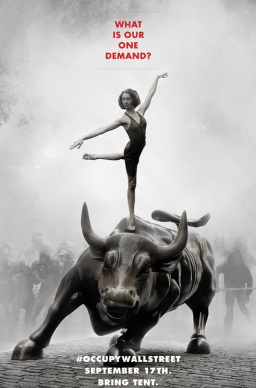
About Occupy Wall Street


Lately, I was thinking about how monetary system work, about the claims in Zeitgeist Movement, and scientific method. All these things I read, watch, and hear started to build up like a snow ball, while I have been pushed to have a job.

How Richard Feynman said about “Cargo Cult Science.”
What Michael Shermer wrote about belief system in “TheBelieving Brain.
How Carl Sagan’s Cosmos talked about “sees the earth as asingle organism
Also, the story in “Foundation And Earth” by Isaac Asimov, which is about the ultimate plan for human’s greater good.
At the same time, I was monitoring “Occupy Wall Street” and other similar movement around the US. Yeah, I think most of videos I saw on Youtube were pretty much pathetic. The point they should make is to spread messages, not to create mass with police.

But I wonder why they felt it is the fault of the top 1% but not the system. As “The Believing Brain” said, human need to personalize things happened around them in order to understand them, just like the old myths talks about winds, rains, volcanoes, earthquakes.
Human being should not be blamed. It is the system we set up long ago that we haven’t thinks much of.
I think people have faith in monetary system is just like religion, many great scientist in history assume the existence of god and unmovable heaven without ever question it. Isaac Newton not only explains how to calculate gravitation, but he also “saw God as the masterful creator whose existence could not be denied in the face of the grandeur of all creation”, and an alchemist. And it is Aristotle who helped to hold the dominant view that the earth is the center of universe for nearly 1300 years.

The ultimate question is: How can we know which thing we believe is relatively right or wrong?
How do we know the system itself is the cause, not individual in the system or other variables?

Scientific method is the best way we know, but it needs time.
I hope it is not too late.

*you should click the link above if you are interestedhttp://www.youtube.com/watch?v=yvfAtIJbatg&feature=channel_video_title#t=05m12sZ

Tuesday, April 06, 2010

The Different One – Exchange Student Experience in Iowa State University

I know I’m different. The different one who does not have much to say most of the time, because the indifference topic most people usually talk about. I am not interested in sharing religious believes, talking about superstitions, searching the best restaurant to eat, involving with other people’s relationships, watching sports, and shopping clothes. That’s almost all the people are talking about, and I don’t have a single word to say.

I’m well aware of that, but I’m not trying to change who I am. Because I don’t need people around me, I don’t feel lonely, and I sometimes feel more comfortable when no one can sense my existence.

But I do care about people. I care to know how we can make this world better, I care how to rethink our education method so we can make our next generation more creative, I care how to improve our government, so that our law, regulation, and policy can truly represent what people really want, I care how to change our financial system so those people who are productive can earn what they deserve.

Iowa State University is a good place for me. Not only because the great amount of knowledge I received, but also the special environment I’ve got to experience. There are nearly 28,000 students from all 50 states and more than 110 countries in this school. At the beginning of the semester, I stayed with a group of exchange students from all over the world: Mexico, Turkey, Singapore, Spain, U.K., Vietnam, Brazil, Norway, and Finland. They are the most different kind of group I’ve ever seen, but I still can share our common interest and value. After that, I mostly hang out with Taiwanese; they are the most kindness one. They do most of the help without considering any payback; even they know I only stay for a semester and probably wouldn’t ever come back. And I also have a good relationship with some Americans. They are the kind of people I have the most interest. I want to know how they are thinking about us, and what their point of view towards the rest of the world is. This is really a great place for my source of inspiration.

As my observation, all of them have very different state of mind; some are smart, with a clever mind; some are very sensitive, often over guessing the meaning of words; some are very talkative, they say as what they think; some are hard working, have to got a job so they can have education; some are dependent, but learned step by step towards independence; some are isolated, because of the culture difference; some are just good people, provide helps whatever they can; some lost their goal of life, don’t know what kind of job they should do; some are selfish, the action and reaction is all about themselves; some enjoy their life very well, have fun at every moment; some want to stay in the U.S. desperately, hoping to have a better life.

All those experience with those very different kinds remind me a little part of me. I have some of those characters some time, but with different circumstance and different level. As experiences of observation and self-examination growth, I figure that the differences of actions and reactions between people are mostly depending on every past experience they’ve got. Although this is a very complex relationship associate with their gene and mental/physical status at the time of event, there still have some clue we can find to make a correct prediction.

But its differences are absolutely what human need. Differences may often cause confusion and misunderstanding, but the differences between us also determines the value of every single individual in this century. Doing the same thing everybody can do over and over again is no longer what society need. Differences make us unique; make us irreplaceable among all 6.8 billion human beings. And Education can let us discover our potential out of differences.

Education

The most things I worry about Taiwan is education, the most inferential and valuable investment. Because the experience I’ve got from more than 15 years of education tells me that Taiwan’s education system is not designed for inspiring creativity, breeding different individual, and preparing needs of future. Instead, the first 12 grade has unintentionally been built to imprison children’s open minds. Students constantly been told to give up what they love to follow a model of success. Even though more and more evidence show that the success of yesterday is not applicable for the triumph of tomorrow. Parents are absolutely eager to spend their money to children’s education. But they fail to spend in the right direction and twisted the whole purpose of standard test. They’ve changed education to a meaningless high cost and useless competition. Then, unfortunately, when students get a chance to decide what to learn for their future in their university, the passion of learning and desire to choice are no longer existed. The only thing left to do is continue this success model until one day it breaks.

This crisis is, of course, recognizable within this island. But during my exchange program, I found out how similar this problem we face all around the globe. Several Singaporeans told me the same things also happened in Singapore. Most of students from Asia don’t know what kind of job they want or what subject or area they are interested in. They see future as an unpredictable path lies on the production line arbitrarily assemble by their parents. Free higher education in Europe sounds like a perfect solution, but the lack of selection process (for students) and limited teaching resource reduce the effectiveness on their system. On the other hand, Americans face their own problem, too. Although their high quality of university education environment makes the whole system more efficient, skyrocketing tuition cost makes them suffer on economic level. Intense unnecessary competition among universities builds up the price. It cost more than just money, but also causes the attainment to defer and even decrease. Only 27.7% had earned a Bachelor's degree(or higher) in the United States.

I believe the solution is out there. Waiting for the emerging of internet technology, government legislation, and most important of all, the mind set of all human to change. The power is in people’s hands if they want to.

We can ask ourselves: What if we redesign our education with an eye towards the future with today’s available technology?

All world governments and education institutions should work together as a single group and pursuit one single purpose: To provide every human being all known knowledge, technique, and method towards the usage for greater good of mankind. We can’t afford to not educate people just because they are poor or their parents couldn’t pay for it. We can’t afford putting teaching resources separated in inefficient way. We can’t afford to give away our education to those self-interest politician and private profit-driven institutions building knowledge walls against open knowledge society.

We, together, should concentrate our education resources to build a world class cyber education system. Truly connect all instructors and students using information technology so feedback can be effectively sent, changes can be made, and improvement can be achieved. Funding is provided by governments to reward good instructors (examined by feedback systems), support scientific research and invention, and build infrastructure for educational purpose. Also, we should systematically eliminate protectionism within the scientific community. Human prosperity should not be sacrificed for short-term profit. Educational books and resources will neither be expensive nor scarce, learning motive will not be suppressed by local policy maker, true educator’s ability can finally reach to everybody, every one of us, on our planet Earth.

Life

From the very beginning when I know I’m going to live in Iowa, I know it will be different. But I was still amazed by so many surprises along the way.
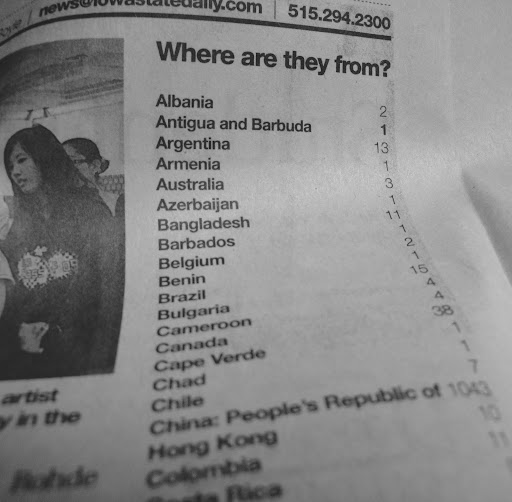
Experience on the first few days of activity with exchange students is exciting. In fact, those students from all over the world make me wonder: How on earth could they gather so many across this wild world? All their languages, cultures, and appearances are so much different. But all of them are able to speak the same language and have the same goal: To live in a foreign country to learn. Although we have greater language barrier and greater culture difference, we generally still have a good friendship.

International students are different. 80% of them came from China, one of the fastest growing developing countries in the world. I didn’t like it at the beginning. This makes me indistinguishable among them. But few months later after I deliberately shout out loud the name “Taiwan” on the international student orientation on the “introduce what country you came from” part in front of hundreds of “Chinese”. I gradually realized the larger picture. After all, we human all came from the same place. Divide people against each other is meaningless.

Population density largely decides the way of life. You cannot buy something hot, cheap, and delicious to eat at 12 p.m. You must travel more distance to get some services. And you find out that sometimes it’s so hard to see human on the street. Although everyone lives far away, people who want to do the same thing can always get together and make a good effort. In some ways, resource for specific activity can be easily concentrated without negative effect on others.

Walking on the central camp in ISU is a joy. In summer time, the brightest sunlight shines, and everything became so colorful to the point where you have to wear sunglasses. In fall, all trees changed its color, and leafs started to fall down. Create a whole new wonderful picture with the fading sun. And in winter, the coldest winter I have ever seen. I experienced the first blizzard in my life, and watched the blowing snow traveling a great speed at 5 degree angle across the ground. Also, I once stood in the middle of a parking lot watching and feeling snow coming down slowly. At that moment, I had no doubt that I found the true peace in my mind.

And maybe, by sharing my thought on this journey to as many people as I could, I can fulfill my duty as an exchange student.

Thanks for all the professors and many university employees on both Taiwan and Iowa who help me so much during this exchange program. From the bottom of my heart, thank you.

Saturday, March 13, 2010

Nervous System

Recently I feel like I have a problem with doing meaningful things. I only have class 2 days a week, have almost no homework to do, and have nothing but my laptop accompany. I don't know why, but something stops me from doing anything productive. Yeah, you can say I'm lazy. But I really want to do something useful.

One night I woke up with this insecurity feeling and started to review my recent life. Almost nothing, nothing is significant enough to stands on the way after Iowa. But at the same time what I can do now is an important factor that can affect my future. So I should find a way to do things differently.

By the way, how many of you guys think of what is the true purpose of life? For what reason human work so hard to live?

For now on, my answer is quite simple. The source of motivation is just the stimulation upon human nervous system.

Saturday, August 01, 2009

Mind Prison

No doubt, school in Taiwan are built like prison, fill with walls, fences, and security guards. Not only prevent contact with outsiders, but also avoid students to get away any easier. Teachers and all the other education system staffs tried every possible reason and excuse to expand the time of schooling. In the worst case, 14 hours a day at school in last several months of 9th grade.

But the real thing they put in those prisons is not actually your physical body; it is your young, free, creative, and innocent mind. Those walls, fences, and guards alone can’t keep you inside a small, tightened, and uncomfortable seat, force you to do thousands of tests a week, and doing nothing but memorizing knowledge whole day that you probably wouldn’t use for the rest of your life. It’s an illusion that trapped, and fooled those minds.

An illusion of having a wealthy and happy life if you do well on all tests just like those people in upper class but not those poor guys in working class.

An illusion that let you think it is worth to give up those dreams and interest you had and end up doing a job you won’t like.

An illusion that everybody believe in; An illusion that everyone in it will try their best to fool others, so the illusion itself wouldn’t break anytime sooner than their death.

I was in that illusion once, but the frustration to give up my dreams is the reason why I have to break out and find another path of life.

Because these things will change,

Can you feel it now?

These walls that they put up to hold us back will fall down,

It's a revolution,

The time will come for us to finally win,

- "Change" by Taylor Swift

Now listen, here I am, my American Dream.

Wednesday, July 08, 2009

Internet, computers, and the generation like me

I don’t know how they call us, the generation of my age. But recently I think I find out some part of reason why we have similar characteristics.
The desire of getting the power to control things is permanently in human natural, and it’s the result of evolution. In other words, naturally, people like to do things that benefit themselves most; people tend to do things they though fit. The reason why some people in my age are so obsess in computers and The Internet is the fact that they often over controlled by their parents. Their life path is fixed in a tiny little box holding in hands, and put into those parents’ perfect production line, trying to make them the exact same sharp as their parents want. So they resisted, and been punished and/or been convinced. Eventually, gave up their childhood dream and being a “good” girl or boy, so they can at least have a peaceful teenage life.
But at the buttom of their mind, they still want to achieve something, to achieve things that others won’t be able to. So those people and two world’s greatest inventions merged. Children can learn how to use these great tools without the rejection of changes like their parents. Children can reach knowledge without the “physical protection” their parents hope to exist. For the first time, children can control things their parents can’t; children are asked for help because their parents can’t figure out; children can have the ability to break the connection limits with the world.
In front of a computer, they can do whatever they want to; they can say whatever they want to say; they can be whoever they want to be. Without the knowledge of their parents. That’s why the generation like me spends so much time on computer just trying to be connected.
Thankfully, that’s not complete a bad thing. The efficiency and ability of collect and filter information is exactly this world needs, right?

Sunday, April 27, 2008

為什麼我們不能期待我們選出來的總統是聖人?

就我這幾年所聽到的,許多人認為我們的政府官員必須經過媒體「最高標準」的監督下,不僅需要具備禮、義、廉、恥,還要和藹可親、勤儉孝順、好善樂施,甚至還要對老婆忠貞不二、不遺不棄。我認為這種思想不僅不正確,還非常的危險,而且很有可能就是阻礙台灣民主進程的元凶。

民主和法治是一體的,民主必須建立在完整的法規底下才能發揮真正的作用,就拿一個明顯的例子:交通部法規「道路交通標誌標線號誌設置規則」第一百四十九條規定,紅實線:設於路側,用以禁止臨時停車。依據此規定紅線是不能停車的(臨時停車也不行),這連小一生都看得懂的東西,為什麼全台北市幾乎沒有任何一個地方有遵守?難道全台北市的人都是瞎子?或許會有人說是因為根本沒有足夠的停車位,但我看過一個小時只要20元的停車場旁邊的「紅線」停滿了車子(原本的雙行道被停成單行道),這要怎麼解釋?

唯一的解釋就是人民的腦中的邏輯區塊出了問題,不僅想要免費停車,又不想被罰錢,車被拖走又怪邪惡的警察和政府聯手A走無辜又窮苦人民的錢,蓋了停車場還是不想付錢。於是可以免費的把車都停到大家付錢蓋的人行道和車道上,再怪政府沒有解決都市停車位不足的問題,然後把狹小壅擠又容易出意外的行人空間留給沒有開車的人,以逞罰他們沒有為全球暖化盡一份心力。

為什麼法律明文規定的事項卻有那麼多人違反?有些人認為是我們錯誤法治觀念或是道德水準的敗壞等等的「人為因素」,但我說那些都不重要,重要的是制度的不完備。制度的不完備導致執行法律的單位就算不執行或「選擇性」的執行(台北市只有重要道路和部分時段有拖吊,其他都是有人報案才去開單,而不會拖吊)都沒有人可以管才是最主要的原因。制度的完備是必須靠專業的立法委員才能一步步的建立,但可惜選民選的只是他們眼中的聖人和打擊另一個政黨的大英雄,而不是只會坐在辦公室裡想著怎麼修改法案的弱者。如果大家只是希望用道德、倫理嘗試改變人類的行為,是絕對沒有機會達成目地的。

回到主題,政府官員的貪污問題也是一樣的,我們絕對不能期待人民可以從外在表現而可以看出一個人的清廉與否,即意味著不能因為一個人是大家心目中的聖人就認為他選上了不會貪汙。反之我們必須參考國外,建立公開且透明的行政和監督制度。因為人性就是如此,以自身利益最為行為動機,道德和倫理的約束只限於淺層的潛意識,遠遠比不上潛藏在深處的動物本性。

"How did this happen? Who's to blame?"

"Certainly there are those who are more responsible than others."

"And they will be held accountable."

"But again, truth be told, if you're looking for the guilty..."

"... you need only look into a mirror."

-originated from V for Vendetta (2005)

Tuesday, December 11, 2007

Steve Jobs's Speech Impression

Original text

我看到覺得驚奇的不是他的想法,而是他對自己所做決定的信心,他居然可以在讀了半年的大學之後就因為覺得自己學不到東西而休學,這是在台灣這種社會環境下很少有人可以做到的。

許多許多的人不知道自己要以後想做什麼,但還是渾渾噩噩的度過了升高中考試、升大學考試,然後還在想著跑去補習考研究所,全部的精神、全部的青春都花在補習考試,不是乖乖的聽爸媽的話「好好唸書,將來輕鬆賺大錢」,就是乖乖的聽補習班講授解題訣竅,然後再聽親朋好友說哪個行業年薪百萬。整個人生都在聽別人說,都不會想想自己想要什麼、喜歡什麼、決定要做什麼,而終究只是活在別人的想法裡,走不出去。然後再被上一代的人說成「沒有國際觀」、「缺乏競爭力」、「草莓族」。

說起來,其實很多台灣人都「知道」上述的道理,但是說一套做一套,腦中被洗腦的程度太深,他們沒有真正理解這些道理而只是「知道」而已。試想以下情況:有個孩子在公立大學畢業,然後孩子突然跟他的父母說要去當農夫,有多少百分比的台灣父母會願意?從觀念上來說,他們花錢教育子女的目的不外乎是想要他們「比較好賺錢」、「擁有比較好的物質生活」,然後以為他們能因此得到相應的精神生活,也就是快樂。如此陳舊腐朽的觀念不但不能使孩子們在成年後擁有多大的快樂,同時為了達成此觀念而在童年時施加了過多的壓力和「填鴨式教育」(因為填鴨式能很快得到成效),導致在孩子童年時期的創造力被壓抑了。最後更為不幸的是,在快速邁向全球化的過程中,最為需要的就是創造力,缺少了創造力,台灣就只是一家昂貴的工廠而已,然後被崛起的「新中國」這間又大又便宜的工廠取代。

Wednesday, July 11, 2007

教育問題

滿臉皺紋、腦袋充滿陳舊腐朽觀念加上老到不能在老的自然科教師,正怒氣沖沖瞪著一班五十幾個善良無辜的小三生,左手手緊緊抓著其中一位學生的雙手,右手拿著一條長達450mm的刑具(好吧,我承認我把45公分的塑膠管說的很恐怖)。

對著全班說:「我今天打你們是為了激勵和督促你們學習,你們的成績讓我根本看不下去。你看看!你考這什麼分數?都考過很多次了怎麼還不會?是不是你不認真嘛?該不該打?..........嗯?」

啪、啪、啪......,巨大的聲響和恐懼一次又一次的傳入那些小小心靈的深處。「我這麼做都是為了你們好你們知不知道阿?不然我吃飽沒事為什麼打你們?打你們我的手我的心也會痛阿!我為什麼不像其他的老師一樣發發考卷就到辦公室吹冷氣?」

「這都是為了你們好阿!」

她沉默了一陣子,讓上一句話在他們的腦袋停留好一陣子,緩和一下情緒後,繼續想辦法說服那些善良的小孩,讓他們以為她真的是為他們好。

「你知道嗎,我以前打的更兇的,大你們好幾屆的一位學長,以前讀書很不用功,讓我教到以後被我打一打就用功起來了,之後考上建中台大,還不忘回來謝我呢!」

此問題的嚴重性不容忽視,不過在世世代代的此種教育方式下,民眾已經完全被同化了,他們非常非常普遍的認為暴力強迫式的教育模式是最為有效的方法,但此行為造成的後果是長大以後的孩子在心理上即認為暴力就是一切解決問題的手段,繼續以暴力對待其他人,現今社會普遍的虐兒、家庭暴力事件就是很好的例子。

不過依據親戚們的聊天內容來說,他們對於此事毫無充分的體認,就在最近社會開始重視校園暴力問題、教育部命令教育機關不得體罰學童的當下,親戚們七嘴八舌的討論著現在孩子多難管、打也不行罵也不行、乾脆不要管等等之類的話題,和批評1980年代出生的所謂"七年級生"他們眼中年輕人所擁有的"次文化"。

我在旁邊聽了很不以為然,他們自己的"主流"文化就會比較正確嗎?他們說現在的教改這裡爛那裡爛,教出了一堆生活白痴跟"程度"(他們所認為的程度)低下的學生。但他們那時的教育就有比較正確嗎?他們邊吃飯邊批評政治亂象、社會亂象、失敗的教育改革、和逐漸下滑的經濟,但想想看這是為數眾多的"誰"在民主制度下造成的?他們有這個自由和權力可以批評這一切,但他們很難說責任不在他們身上。(難道在那些生活白痴又沒有競爭力的小孩身上嗎?)

大眾的觀念沒有改,再明志的教育改革也會被說成是暴政,在遭受補教界、家長、老師的壓力下被改爛,然後被說是加大學生壓力(誰加的壓力?)、減低學生程度(所謂程度是指他們沒有把各版本參考書上的東西背下來)、政策搖擺不定(不知道是誰叫他改來改去)、毫無效果和忽視窮人權利。

大眾的觀念沒有改,再聰明的小孩也會被說成智障,在補教界、家長、老師的圍毆、叫罵之下強迫學習,然後被說成是生活白痴(誰說不用管別的事,只要用功唸書就好?)、草莓族(誰種出來的?)、沒有競爭力(原來分數考的高就會有競爭力喔?)。這跟父母說孩子很笨,小孩頂嘴,就打小孩打到變笨了是一樣的道理。

想要有成功的教育,必須從"大人"們的教育做起。

Sunday, July 08, 2007

大自然、科技、人類與人口 2

接續大自然、科技、人類與人口 1 在上一篇的文章中,我得到了結論。 「人口的過量增加,是一切污染的來源」 人們極端的歸咎於科技的發展是另一種逃避現實的作法,全世界的所有人類如果真的拋棄所有幾千年來所建立的科技,"迎向"大自然,回歸"大地之母"的懷抱的時候,那將會是人類文明的一場大悲劇。 想像一下,人們捨棄現代醫療技術(預防針、剖腹生產、各種藥品)、現代交通運輸(車、船、鐵路)、生產各種物品的工廠、供水供電系統、石化能源(煤、石油、瓦斯)、種田的機械、家家戶戶的空調(是的,包括你家房間那幾台)、衣物鞋子(不要懷疑)、還有各種眼鏡(不要求我還你)。許多許多我們依賴的基本物品都是維繫著我們存活的基本要素,以目前的情況來說,缺少其中一個都會造成極度嚴重的後果。 疾病大流行、嬰兒存活率偏低、食物無法及時運達且容易損壞、缺乏衛生、沒有能源煮熟食品、農產量大減,結果就是全世界的死亡人數瞬間飆高、超過了人類有史以來所有戰爭之死亡人口總和! 說是地獄恐怕還無法形容這個世界。 當然,這種事沒有可能發生,人們一旦了解會發生這種後果,將不會拋棄其中的任何一樣。 (但還是有人以為他們的生活可以完全不牽涉到科技,遠離人群、現代生活,住到偏遠的山區,以打獵、農耕維生。但你可以光從這句話看到科技。他用樹枝打獵嗎?用手掘土?然後用獸皮製衣服和鞋?再者,如果人人都這樣住,地球根本不可能有空間可以塞下60億人口。) 「人口的過量增加,是一切污染的來源」(是的,我在對你洗腦) 人們在這段輝煌的2000年歷史中,不斷的擴展其生活空間,砍森林、殺動物,從河岸海岸擴展到丘陵高山、從氣候溫和到炎熱嚴寒,全部都住了滿滿滿的人。人類在地球眼中像病毒般,殺光檔在前面的生物植物、踏平土堆、填平水流,2個生3個、3個生9個,死亡率大減、出生率大增,從百萬到千萬、從千萬到上億,迅速侵略整個地球。 人類做錯了嗎?嘗試讓自己活著錯了嗎? 不要懷疑,人類的確做錯了,但不是錯在嘗試讓自己活著,而是錯在其缺乏知識的行為已經根本上的危及到人類本身的生存了。 知識及科技使人活的更久、活的更好,過程中製造污染在當時無可避免,但在知識進步的過程中,人們了解污染其未發生但未來將可能發生的後果,經由民主的力量(對許多國家的人民來說這是個夢)讓人們即時解決問題,防止進一步的危機擴大。 人口問題將會是人類本世紀迫切需要解決的問題 至於解決方法,說起來很簡單,但目前只有少數國家有可能做到。 簡單兩個,知識、民主 人民充足的邏輯知識以及運作良好的民主

Friday, July 06, 2007

台灣的國家、政府、人民所構成的民主力量

在台灣,你會看到一個很奇怪的現象,人民普遍的對政府沒有信心,對立法院失望,對媒體反感(不信你去街上問問看)。但不知道他們有沒有想過這一切之根本的問題出在哪裡? 這裡是一個民主國家耶,立委是人民選的、總統是人民選的、甚至還可以用一根手指就可以選擇媒體。但我天天看到的依然是患上嘴砲病的病人在立法院打嘴砲還練打架、自虐狂患者心甘情願的出現在電視上被打嘴砲、更有自以為平凡小市民的罪魁禍首們喜歡看自虐狂和嘴砲病人在電視上演比台灣肥皂劇還爛的劇本、和不專業導演團所提供不保證完整及真實的音訊視訊。 這可以說是台灣民主力量構成的一番景象。 當然,並不是所有人都是自虐狂、嘴砲病人、罪魁禍首和不專業導演團,但人們必須意識到他們究竟出了什麼問題,並尋求解決之道。 有人悲觀且半開玩笑的說乾脆扔幾顆核彈在台灣一了百了,有人想當作這件事不存在或根本否定此現象,但總沒提出辦法來。 修身、齊家、治國、平天下,這句話本來的意思是如果一個人連自己的家庭都管理不好是不可能治理好國家的之類的爛道理(該死的獨裁思想)。 我的新解釋是:如果人民有完整的知識能請楚的了解做出什麼決定能符合自身的最終利益(修身),那麼在良好的民主制度下,家庭、社會就會得到安定(齊家),國家就會富強(治國),世界就能達到和平(平天下)。 於是我扯回了教育。 該死的教育,咱們下次再談談你。

Thursday, July 05, 2007

大自然、科技、人類與人口 1

如往常一樣,辛勤工作的人們到了假日有時候會想到未開發的郊外走走,接觸一點繁忙都市平常所沒有的清新的空氣、遠離人群的安靜。然後看著緩緩流動的小溪、腳底踩著軟軟的泥土,然後深深的嘆了一口氣。 為什麼我們不能天天生活在這種地方呢? 但很少人真正知道究竟為什麼我們要捨棄大自然,然後住在治安亂、環境差、人多到伸手說聲Hi都會打到人的都市。 有人歸咎於我們發展過多科技,一切的根源來自人們對於信仰的遺棄、道德的墮落,因此要我們找回信仰和道德(我不知道這句話要怎麼說才說起來才會具有說服力),重回大自然,放棄一切科技(他們認為"邪惡"的科技),然後大家從此過的幸福快樂。 這些人指出,科技根本沒有提供他們更好的生活,每當有新的科技出現也會帶給我們苦難,他們舉出的例子如下: 工業活動製造的製品和剩下的廢物造成的汙染(塑膠製品、重金屬汙染、廢水、清潔劑) 車輛、飛機、船隻所排放的廢氣和製造的噪音 各類電廠造成的環境污染(水力:危害溪流生態,火力:粉塵和二氧化碳,核能:珊瑚白化和核廢料) 電台收發站造成的電磁波(有人說會提高癌症的機率,但未經證實) 不管什麼人來看這些都覺得毛骨悚然,的確,這是人們知識貧乏和短視近利的後果,不過這卻是維繫現在人類過於龐大的人口所需要的代價(用"過於龐大"的字來形容顯然不足)。 從古時候說起,人類並沒有很高的存活率(跟現在比較),而經由火和石器的使用、農業開墾、畜牧發展和知識累積,人類數量大為增加(主要因為有充足的食物養活族群),而對於有限的土地來說,戰爭便無法避免,成為控制人口的重要因素(但總人口還是在增加)。工業革命起,人類在科技發展上有了大進步,更進一步帶動了各種科技的進展,特別是運輸、醫療、衛生的方面。一方面運輸造成人口擴散速率和知識流通加快、二方面嬰兒存活率上升和死亡率下降,進一步提高人口數和科技進步速度。人口呈等比級數上升,上升,再上升。 20世紀的兩次世界大戰並沒有對世界人口造成多大的衝擊,電腦和網路的發明繼續加速科技發展,相同的土地面積得存有更多人口數,直到今天。 問題來自於人口。如果我們不想要有汙染,不想要失去美麗的大自然,不想要有戰爭,想擁有幸福快樂的生活,就必須要控制人口。(雖然說有研究指出快樂程度跟平均生活水準沒什麼關係,與他人比較起來的生活水準才是快樂的泉源)

Thursday, June 07, 2007

Decide an Action

許多電影、書籍、卡通在描述一個人在決定一件事的時候,都會形容有個天使和惡魔在他的腦中爭吵,試圖影響那個人的決定。不過那也只是一種誇大表現手法而已,我認為真正人們在做決定時其實不只有天使和惡魔,不只有純粹的善與惡,而是綜和價值、道德、經驗和潛意識等等的觀點而得到的結果。
這整件事很像一堆人在拔河
而目的是使中間那個交點越靠近自己越好。當然,每個人的拉力不同,也就是說每個觀點的影響力不同。最後,得到在空間中的某一個解,而那就是他最終的決定。
昨天我很大方的向一個對我按喇叭的駕駛比了一個乾淨俐落的中指,而上面的文字是我後來對我自己分析了一陣子而得到的結論。(我走在斑馬線上還敢按我喇叭,法律是定假的?)

Sunday, May 06, 2007

Letters from Iwo Jima

我在家裡看了Letters from Iwo Jima (來自硫磺島的信) 是以日本人的角度去看在硫磺島的戰爭,以日文發音,但字幕是英文。 看到一半,忽然覺得我似乎什麼都搞不懂,我聽不懂日文,也看不懂英文,看完 影片後去看電視甚至連台語都聽不懂了。 噢,不要在跟我說什麼其他語言了,我討厭語言的隔閡。 我看公視的一個有關中國大陸在經濟發展下種種問題的節目,我可以很清楚的看到,現今中國許多嚴重的問題都來自於那邊的政治制度,宗教不自由(雖然我討厭宗教)、社會不安定、人民土地財產沒保障、更缺乏獨立做主的司法機關。我深深的認為如此發展下去,中國的進步會與相對落後於其他國家的政治制度產生衝突,在將來必定要解決,如此中國才能成為現代化國家(然後吃掉台灣?)。 然而,在這部將焦點放在中國社會問題的影片中我看到了其他的東西。 他們的語言究竟有沒有統ㄧ阿?影片鏡頭從西藏轉到北京轉到上海轉到不知名的鄉下,其中各種地方的人說的各種方言雖然有其相似程度,但是如果你把我們平常說的國語跟台語區分成兩種語言的話,那麼我在影片中看到的就是許多許多不一樣的語言,他們如何聽懂對方的話?如何跟其他人溝通?這會是中國進步的絆腳石。 我認為,在全球人類希望能有更好的生活時,必須要突破語言的障礙,彼此才能更加緊密的合作。 For a better life, we toast.

Tuesday, May 01, 2007

Action

我認為,人類的所有行為都有誘因 就是追求最大利益 而不一樣的人在相同的環境會做不同決定的原因是思考歷程或價值觀的不同 一個人的思考歷程和價值觀由他生長的環境和基因決定 當一個人在思考怎麼對一個外在變化作出反應時,會瞬間在大腦中讀取相關資料,並依照其意識或潛意識中的價值觀的運算式做計算,得到結果後依照其結論大略形成因果關係(如果如何做,可能會如何等等),最後依照其最大利益,做出適當的反應。 有個以前發生的事可以驗證一下 傳說中,一個叫做西松的高中,有個人曾經在那唸過三年並不是怎麼爽的高中 就是我 我對班上值日生的公平性並不是怎麼滿意,常常換我到廚餘的時候,廚餘桶已經是堆積了5天以上了,桶中的蛆到處爬、臭味四溢,加上本人身型瘦弱沒什麼力氣(廚餘很重,本來天天倒應該不會很重),把那桶廚餘倒掉時怒氣已經破表了。經過幾天仔細的觀察發現,總是因為有些人因為種種理由中午"有事",所以都"沒時間"倒(卻有時間打屁聊天),因此決定不想繼續當姑息主義者,每次只要前一天有人沒倒我就會跟很無奈的衛生股長說"為什麼前面的人可以不倒?他不倒我也不倒!",很奇怪的是從此以後我就很少很少倒過了,因為就是有人喜歡當爛好人,每次都看他很辛苦的提著廚餘桶跑來跑去。 對此非常看不慣的我有一次跑去跟那個爛好人遊說了一陣,將其中的利害關係通通說了一遍 "你阿,這個爛好人,你這是在做啥?免費清潔工阿?你知不知道你這是在養大那些白目不做事的人的胃口?" "可是.....總要有人倒吧....?" "對,總是有人要倒,但那個人不會是你,而是那些白目,你只要學我跟衛生說既然前面的不倒我也不倒就好啦!,衛生股長會去找誰?誰先不倒就找誰!這樣你不是輕鬆多了嗎?中午午休可以睡到翻了!對不對?" 經過了那個人腦中的運算,他照著我說的做了,我也知道我成功的改變了他腦中的思考歷程。 關鍵是上面標為粗體的字

Wednesday, March 28, 2007

人類基本思維

我認為 人類基本的思維建立在自身的利益上 人類大部分行為維繫著利益 以利益為最終目的 (在此定義"利益"的範圍很廣,例如純粹試著讓自己感到快樂也是一種追求利益的表現) 如果你試過檢視自己的行為 你可能會發現這種思維所帶來的影響(雖然說很難) 近幾年來空閑的思索和知識的吸收對此理論有很大的幫助 因此決定要寫一些出來,順便使我能清理一下原本不怎麼整齊的思緒 建立在此思維之下 看似人人都會是那種傳統教育所塑造出來那種自私自利損人損己的類型 但其實如果大家都能夠追求自己的"最終利益",最後做出來的事反而會趨向大家的共同利益 (上面是看起來很討厭的敘述句,下面舉個例子,以免你看了厭煩關了瀏覽器了事) 某某班上的五個同學很要好,中午下課的時候偶爾會各自到外面去買飲料喝 有一天A同學出去買的時候覺得異常的累,想著如果有人可以幫他買就好了,因此便扥了B去幫他買,而B跟則他說如果下一次他累的時候也希望他能幫他買。 因此他想出了一個好方法,他找來其他的人,問他們願不願意以後都只要一個人輪流去買就好了,其他人就不用重複走同樣的路去買。 看到了嗎?最初的想法是自身的利益,但最後因為大家也追求自己的利益(總不會有那種有自虐傾向的可憐蟲每次都自願去買吧?),所以最後變成大家的共同利益。 相同的概念 人類追求自身利益,而趨向互相合作。 充分的合作,形成有制度的組織。 組織間因利益衝突(自然資源)、文化隔閡、猜忌,開始兼并、融合或互相毀滅,統一為國家。 國家與小型組織不同的地方在於帶來的損傷程度,於是出現了幾個世界大戰。 (真正的民主國家與獨裁國家的分別在於,一個參戰的理由可能比較接近大眾的利益,一個則否) 二戰後,為數不少的地球上的人們因此了解到戰爭帶給大家的好處也許不一定比壞處多,雖然因此各國政府參戰所帶來的輿論壓力增加了,但畢竟有些事不是武力以外的行動能夠解決的。 美國拖垮蘇聯後的"單極世界時期"便運用其軍事實力鞏固他在中東石油的能源(維持經濟力量的要素),引起了許多人的不滿,甚至仇視。 但相信如果別的民主國家也能有如美國一樣的經濟和軍事力量,依照其國民本身的利益來說,政府會做同樣的事(獨裁政權就更不好了,他們為的只有自己的利益)。其他國家人民的仇視、反感來自於內心深處不確定的恐懼(和宗教的洗腦),畢竟美國民主制度下做出決定不一定會符合他們的利益。 人們相處在一起的方法靠的是彼此利益的平衡,交通、通訊、網路加速平衡過程,並且在平衡中加速交通、通訊、網路的發展,人們如此就會更加了解彼此的想法,也能保有共同最大利益。 即是為了更好的生活 微雨的異域,漫步在落葉紛飛的樹林,我嘆了一聲。 又一個想法

Saturday, January 13, 2007

錯上加錯

來看看Csientieic American的文章"錯上加錯"

http://sa.ylib.com/circus/circusshow.asp?FDocNo=948&CL=23

看完這個,你還需要相信一些根本不經過實驗的東西嗎?

那些東西對了嗎?

不,不要說它對了,甚至連錯都談不上。